Honeywell EBI
Integration Guide

This integration connects Sine with Honeywell EBI access control systems, allowing visitor and access credentials managed in Sine to control physical access permissions directly through EBI. It enables organizations to streamline visitor and access management by synchronizing access rights automatically, reducing manual administration and improving site security. This guide is intended for system integrators configuring the connection and IT administrators responsible for managing access control settings.
Overview
This integration connects Sine with Honeywell EBI to automatically provision and revoke visitor access credentials. It supports Sine QR Code credentials, which are assigned via QR codes printed on visitor badges or sent via SMS. Access is granted and removed automatically as visitor status changes in Sine.
How It Works
Sine integrates with Honeywell EBI (Enterprise Buildings Integrator) to synchronize visitor credentials with your access control infrastructure. When a visit is approved in Sine, the corresponding credential is provisioned or activated directly in Honeywell EBI, allowing visitors to move through compatible readers without manual intervention from front desk or security staff.
QR Code
Visitors are issued a Sine QR Code credential that can be scanned at compatible readers, allowing Honeywell EBI to grant access based on the visitor's assigned access groups.
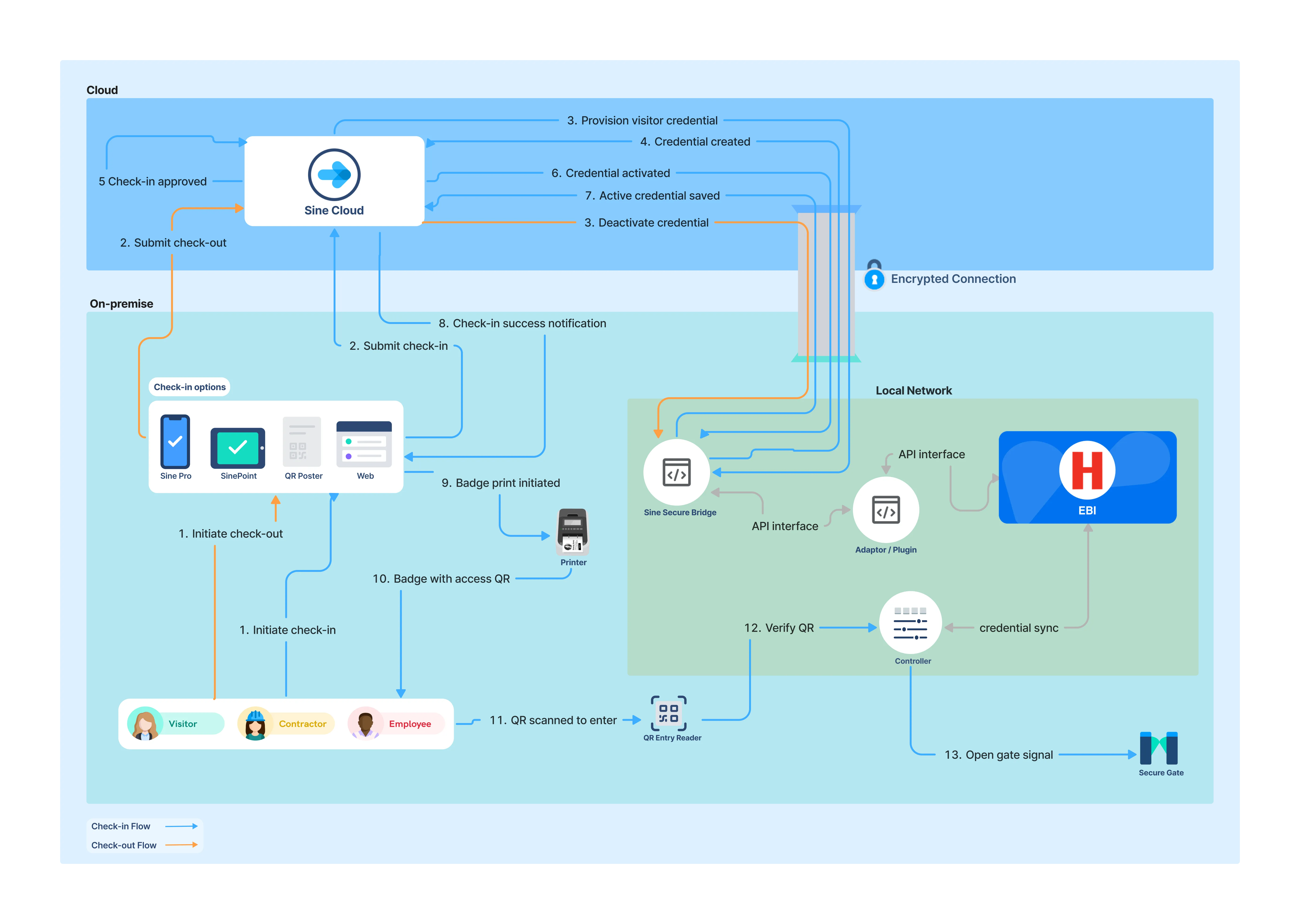
Check-in Flow:
The visitor initiates check-in through Sine, using a kiosk, the Sine mobile app, a web-based check-in form, or by scanning a printed QR poster.
Sine provisions a unique QR code credential for the visitor, scoped to the access groups assigned for the duration of their visit.
Once the visit is approved following required security and compliance checks, Sine activates the QR code credential in Honeywell EBI.
Sine delivers the QR code to the visitor via SMS or displays it on their printed or digital badge.
The visitor presents the QR code at a reader with QR/barcode scanning support, and Honeywell EBI unlocks the door.
Check-out Flow:
The visitor checks out using the Sine app, a kiosk, by notifying their host, or automatically upon exiting the geofenced area.
Sine revokes the QR code credential in Honeywell EBI, preventing any further use of the credential to gain entry.
Requirements
Sine Requirements
- Integration enablement: Confirm that your Sine subscription supports the Honeywell EBI integration and that it is enabled on your account. Additional fees may apply.
Honeywell EBI Requirements
- API License: Obtain an API license for remote credential provisioning.
- Data adaptor: Install the Sine data adaptor within EBI. This middleware, developed by Honeywell, translates Sine's credential payloads into a data format compatible with EBI.
- QR Reader: If you plan to use QR codes for access, confirm compatible QR access readers with Honeywell or your Access Control Integration Partner. A reader similar to this is suggested.
- Credential pool: Ensure you have an available credential pool if you are using physical access cards.
- Testing environment: Set up a sandbox environment or another safe testing space for configuration validation.
- Network connectivity: Determine the method you will use to connect Sine with your on-premise Honeywell EBI system.
- Direct API access: Requires network firewall access to the Honeywell EBI API from outside your network.
- Sine Secure Bridge: Requires installation of the Sine Secure Bridge agent to establish a secure, managed tunnel between your on-premise Honeywell EBI system and Sine.
Configuration
Honeywell EBI Configuration
EBI Configuration
Enable API access — Enable API access or open protocol support (REST API) in Honeywell EBI.
API credentials — Create API credentials, or configure system access permissions to allow credential provisioning.
Access zones — Configure access zones and permission groups to control visitor access.
Credential pool — Confirm that a credential pool or credential issuing capability is available.
API documentation — Prepare the relevant API or protocol documentation for use during Sine integration setup.
Sine Configuration
General Setup
Admin permissions — Ensure you have Team or Site Admin permissions. These are required to configure integrations.
Log in — Log in to the Sine admin dashboard.
Select site — Navigate to the Locations tab and click on the site you want to configure the integration for.
Add integration — In the Site menu, click Integrations. Click the Add integration button and select Honeywell EBI from the list of available integrations. If the integration does not appear in the list, contact support.
Name integration — Enter a name for the integration. You can use any name, but choose one that helps you identify its purpose.
Connect to Honeywell EBI
Connection Method
There are two ways to establish network connectivity to your on-premise Honeywell EBI instance.
Select your preferred method below.
Sine Secure Bridge enables a secure, managed tunnel between Sine Cloud and your on-premise system's API.
Enable Secure Bridge — Switch Use Sine Secure Bridge on to display a dropdown list of your Secure Bridge tunnels. If the Sine Secure Bridge toggle is not visible, contact your Sine representative.
Documentation — For more information on installing and configuring a Sine Secure Bridge tunnel, visit the Secure Bridge Documentation.
Authentication
API Key — Enter your Honeywell EBI API Key and your External ID. The External ID can be any value.
Test Connection — Click the Test connection button to confirm that your configuration is correct. Once Sine has successfully verified the connection to your Honeywell EBI account, the Integration Settings section becomes available.
Integration Settings
Credential Configuration
Controls the type of access control credential that is generated when the integration runs.
Select your preferred credential type below.
Generates and attaches a QR code to a visitor's pass. The integration runs when a pass is created or expires, or when the visitor checks out.
Send QR Code by SMS — If the visitor's mobile number is available, send them a QR code credential to their phone. This can serve as a useful backup to a badge printer.
Provision credential on check-in — Select one or more visitor types for which you want the integration to provision credentials in your access control system when the visitor checks in using Sine. Ensure the Host Selection Required checkbox is ticked for any visitor types used in access control integrations. Without this setting, visitors would receive access credentials without host approval. You can review which of your visitor types have Host Approval Required in the General tab of your site settings.
Grace Period — A visitor may check out using Sine before leaving the location but may still need to use their credentials to exit. You can set a grace period to ensure their access control credentials are not deprovisioned immediately upon check-out in Sine.
Basic Configuration
Connection details — Enter connection details specific to your access control system (API endpoint, credentials, IP address, or COM port).
Field mapping — Map Sine visitor fields to your access control system's cardholder schema.
Test connection — Test the connection and enable auto-provisioning for visitor check-in.
Messages
- Visitor failure message — Configure the message displayed to the visitor if the access control integration fails for any reason.
Notifications
- Send integration failure notifications — If the integration fails, you can enter one or more email addresses to be notified of the failure and its corresponding details.
Testing
Create a test check-in — Create a test visitor check-in using a visitor type configured for the integration.
Verify credential provisioning — Verify that the visitor profile is created in the vendor system and that credentials are provisioned correctly.
Test credential access — Test the credential at a compatible reader to ensure access is granted.
Verify credential revocation — Check out the test visitor and verify that access credentials are revoked after the configured grace period.
Check failure notifications — Monitor the integration failure notifications to ensure they are working correctly.
Need help? Contact Sine Support at [email protected]